About iLOGY Praxis
iLOGY is a generative methodology of performance through theatrical and all forms of artistic, literary, expressive modes. It seeks to focus on the sense of i and its deep relationship with memory and ecology. It’s a way of remediation of the past and of finding this i performer/storyteller/artists as a filter through which the future will form – less automatically and with more autonomy.
iLOGY – a shack along your way
by Sudipto Dawn
A few of us, and in naming i would be excluding, as so many people, events, accidents which have been with us and influenced our approach & thoughts. But for practical purposes, we pursued theatre of a kind which constantly wanted to break the shackles of being and always become. There was no way that any existing praxis of theatre or telling a story can fit in exactly in our lives, and there is no way that we would be able to fit into their requirements and ideology. In the process of creative evolution iLOGY praxis can then be only a reflective medium. We are an experience on which one can reflect, we would not want to be the destination nor a container. Just a shack maybe in your long journey where we catch up for a few sessions of adda and share a bit of what we know and experienced.
Love & Delight (Shringara) is the primary rasa which draws us like fireflies into the immense suffering at times, only with the hope that we will recover that feeling – a whole bunch of industry has grown out of this, wars have been fought – and perhaps the hopelessness of all this leads one to seek for the blissful state (shanti rasa). Who knows? However it is true that none of this has helped averting in erasures and alteration through colonization – the biggest victim of which has been the ecology & culture both of which has been flattened – and the bir (heroic) rasa has only contributed toward it bibhasa (disgusting) destruction and the consequences are bhayanaka ( terrible). Order is for the armies of destruction, for poets, our kind of storytellers and lovers – it is the wilderness and the unknown, more of the edges, corners, masks, nothingness and beyond.
Ways to witness memory, see how it has been mediated, how the body reacts – as if like that animal we are taught we are – fight or flight, that we are evolving from apes – that still some of haven’t quite made the mark – yet. Well what is an autonomous body mind? Unlearning and remediating memory – we thought why not while we put on a different track – maybe this time of rasas & (other such things which we can find in the ancient past or in our immediate vicinity which tatses nice). Dive in with a bit of this and see what happens, what are we seeking and what do we sense now? Looking back with some Karuna (kindness) perhaps like that of Shakuntala (too much to ask in real world).
Queerness is as marginal and central depending on the way i experiences it – so as much as the performance theories are about how the west (not necessarily a geographical entity but perhaps also an intellectual and cultural one) performed their identity thoughts and values, much of the way the other world performed was appropriated and mediated through the western lenses and a certain vocabulary, modes and methods were bench marked and idolized while the rest was spoken of as this and that – well experimental, exotic, etc. All this institutional categorization is fine, but what does it do to our (not identifying with the normative west as mentioned above) body mind, our soul – to this i. This question haunts us and makes us mindful of the Laxman rekhas of this and that, well in theatre we rather meet the Ravana and get kidnapped anyways to see what queerness looks like. As long we are not exiled by Rama to end the tale. Well the other side is filled with wonders not in comparison but like in everything in sensing directly the depth of the i and the i’s, which are not always necessarily human or animate and real entities but abstract concepts like culture, experiences, technology, etc. After all who is experiencing and how one is experiencing – ways of witnessing and sensing is what one meets with iLOGY.
This shack then, is on a ragged serpentine road, somewhere between Bohemia (aesthetics) and Utopia (mystical), hidden besides a lake nestled under a canopy of pine, cedar, oak, where the i sits on a bed of wildflowers moist with the morning dew. Silent, smelling of the rain washed forest, with the breeze sweeping through with the sound of birds and the occasional far way truck horns passing to the other side. Soon the dusk will slip into the a dark green horizon, where the million stars will meet the thousand filaments of tungsten, phosphor, glass & sapphire. Soon the rivers will swell with a mountain of memories , with i as a witness and be wedded with the choppy waters on a noisy motorboat somewhere along the mangroves where the tale of Bono Bibi, Manasa, Shitala, will be retold.
iLOGY philosophy & practice
by Janardan Ghosh
I do not begin with the conventional question, “How does one tell a story?” i begin with a more elemental and potentially unsettling enquiry: Who is the “i” that wishes to tell?
What is this “i” that stands before an audience, recalls a memory, utters a poem, draws an image, assumes a gesture or claims that a particular story belongs to it? Is the “i” the body? Is it a name, a profession, a nationality, a gender, a language, a collection of experiences, or the accumulated residue of cultural memory? Is it the conscious author of a performance, or is it itself being authored continuously by family, ecology, history, desire and circumstance?
iLOGY emerges from these questions. It is not a fixed technique of acting or storytelling, nor is it a therapeutic system, a spiritual doctrine or an academic theory in isolation. It is a performative philosophy and an evolving praxis through which the participant examines the architecture of the self and its relationship with memory, culture, ecology and the larger field of existence. We at Culture Monks describe iLOGY as an original performance methodology that reimagines theatre as a process of enquiry, embodiment, memory and becoming. Its practice consequently approach performance not merely as artistic representation but as a way of investigating how identity is shaped through the body, imagination, cultural inheritance and place.
The lower-case “i” in iLOGY is important. It does not announce a sovereign, self-sufficient ego. It is a small mark placed within a much larger creation. The dot above the vertical stroke may be read as a bindu: concentrated yet open, individual yet cosmological. The “i” is present, but it is not the centre of all existence. It is a participant within existence.
The practice therefore asks: Where am i placed within this enormous theatre of creation?
The “i” and the Five Sheaths
One of the philosophical frames through which we approach this enquiry is the ancient Indian conception of the pañcakośa, the five sheaths of embodied existence articulated most notably in the Taittirīya Upaniṣad. The human being is understood not as a singular, isolated substance but as a layered constitution composed of the annamaya, prāṇamaya, manomaya, vijñānamaya and ānandamaya kośas: the (Physical) food-body, the vital or breath-body, the mental-emotional body, the discerning or knowledge-body, and the sheath of bliss or deep integrative being (Taittirīya Upaniṣad, II.1–5).
i do not introduce these sheaths to participants as anatomical compartments or as an exotic metaphysical diagram. i treat them as interpenetrating fields of experience. Each sheath offers a possible doorway into performance.
The annamaya kośa reminds us that the storyteller is first of all a material body. This body has weight, temperature, fatigue, appetite, posture, rhythm and vulnerability. It has inherited habits. It carries marks of age, labour, nourishment, injury and social discipline. Before a participant is asked to “perform,” i often ask the person simply to move, sit, bend, pause and notice. We meditate on a few fundamental questions. How does the foot receive the earth? Where does the spine resist? Which gesture arrives repeatedly without conscious decision? What happens to the shoulders when the person speaks of authority, childhood, shame or desire?
We do not regard the body as an obedient instrument commanded by the mind. The body is already a narrative archive. It remembers what the conscious intellect may have forgotten.
The prāṇamaya kośa brings us to breath, pulse, vibration and energetic movement. A story changes when breath changes. A sentence spoken from a restricted chest is not the same sentence when allowed to descend into the abdomen. A remembered landscape shifts when it is accompanied by sustained exhalation, interruption, humming, trembling or silence. Voice is not merely sound produced by the vocal organs; it is breath encountering resistance and becoming relation.
The manomaya kośa opens the field of thought, image, affect and association. Here a fragment of rain may summon a grandmother, a railway platform, a lost lover, the smell of wet books or an unnamed apprehension. The crow may relate to death. The mind does not always remember sequentially. It leaps, overlays, repeats, conceals and transforms. In iLOGY, we do not immediately correct this apparent disorder. We allow the participant to enter the associative architecture of memory.
The vijñānamaya kośa introduces discernment. The performer observes the material that has emerged and begins to ask: What is personal here, and what is cultural? Which images are inherited? Which responses have been socially conditioned? What ethical responsibility arises when I perform a story involving another person? What have I altered by narrating it? At this stage, performance becomes reflective research rather than spontaneous confession.
The ānandamaya kośa is perhaps the most difficult to discuss because ānanda should not be reduced to happiness or emotional pleasure. Within the practice, it may be approached as a moment of integrative presence: a temporary condition in which performer, material, action and witness cease to feel completely separate. The participant is neither displaying an emotion nor protecting an identity. Something is experienced directly. The practice describes this movement toward anubhūti, lived or immediate experience, as distinct from merely reconstructing the past or illustrating an idea.
The pañcakośa framework allows the “i” to be encountered as plural and layered. The “i” is not only what it says about itself. It is food, breath, sensation, memory, cognition, discernment and the occasional experience of an un-fragmented presence. It is an organism before it is a biography.
The “i” among the Five Elements
The pañcakośa enquiry becomes more expansive when placed alongside the pañcatattva or pañcamahābhūta: earth, water, fire, air and space: pṛthvī, ap, tejas or agni, vāyu and ākāśa. Across Indian philosophical systems these elements carry differing ontological and cosmological meanings. In the practice, i use them not as simplistic personality categories but as material, sensory and performative provocations.
Earth asks about weight, support, territory and belonging. What ground formed me? Which landscapes continue to speak through my vocabulary and physicality? How do caste, class, labour, migration, architecture and access to land shape the body that says “i”? Earth is not an abstract symbol; it is soil, food, ancestry, shelter and dispossession.
Water brings flow, adaptation, memory and dissolution. Water refuses the fantasy of a permanently bounded identity (the oceanic feelings). It enters, leaves, evaporates, returns and assumes the shape of its container without becoming identical to it. Participants may work with memories of rain, rivers, kitchens, bathing, thirst, tears, floods or oceans. A performer may begin with an autobiographical memory and gradually discover that water connects the personal to the ecological and political.
Fire brings hunger, transformation, anger, illumination and destruction. Desire itself has a fiery structure: it reaches, consumes, modifies and seeks continuation. In performance exercises, fire may be approached through accelerating rhythm, focused gaze, repetition, spoken insistence or an image that refuses to disappear.
Air enters through breath, sound, direction and mobility. It is shared without being possessed. Every spoken story is carried upon air, and every listener receives traces of the performer materially through vibration. Air makes evident that communication is not purely semantic; it is corporeal and environmental.
Ākāśa, commonly translated as space or ether, is not treated merely as emptiness. It is the enabling interval within which sound, gesture, relation and imagination may arise. The Culture Monks ākāśa practice, developed as a voyage beyond conventional storytelling, drawing elements from the Upaniṣads, the Nāṭyaśāstra, the Tantrāloka and Bhakti traditions, combining listening, voice, movement, image, reflection and performance.
The “i”, viewed through the pañcatattva, is not standing outside nature and observing it. The body is earth-containing, water-bearing, heat-producing, air-breathing and space-inhabiting. The elements are not scenic backgrounds for human drama; they constitute the performer.
This recognition complicates the modern human desire to establish presence. We want to be seen, named, recorded and remembered. We announce ourselves through photographs, performances, possessions, institutions and digital profiles. Yet the elemental body quietly contradicts our claims to independence. The air i call “my breath” was not produced by me. The water circulating in my body preceded my biography. The food-body is assembled continuously from the more-than-human world. The space i occupy is possible only because other beings and bodies have yielded, shared or been displaced.
iLOGY does not ask the participant to erase the “i.” It asks the “i” to become more accurately situated.
Performance as a Laboratory of the Self
Performance is central to this enquiry because the self cannot be understood by conceptual discussion alone. One may speak eloquently about embodiment while remaining physically absent. One may discuss emotion without allowing breath, gaze or muscle tone to change. The iLOGY practice therefore uses poems, literary passages, personal memories, drawings, found objects, sound, movement, ritual structures and story-performance as laboratories through which the self becomes perceptible.
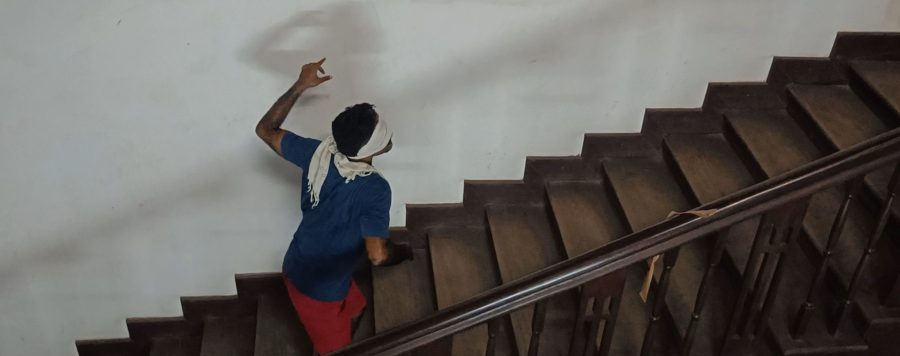
A poem written by one of our participant, for example, is not approached only as a text to be interpreted. i may ask a participant to locate the poem in a specific part of the body. Does it reside in the throat, the lower back, the palm, the tongue or the space behind the eyes? What happens when one line is breathed rather than spoken? What if the poem is walked, whispered, fragmented or addressed to an absent person? What if the participant draws the poem before performing it? Or what happens when you perform it on a spiral stair case or on the rocks by the sea?
Drawing [Six image Story] while developing a performance piece is especially valuable because it temporarily interrupts linguistic authority. Participants who are articulate often believe that they know their experience because they can explain it. But an image may expose an organisation of memory that speech has domesticated. A disproportionately large door, a tree without roots, a body placed at the edge of the paper, a recurring spiral or an unexplained patch of darkness may become the seed of a performance. The purpose is not psychological diagnosis. The drawing is treated as a performative score: a set of spatial, rhythmic and relational possibilities.
In Katha’koli, my evolving story-performance practice, the written story is released from the page through voice, pitch, rhythm, gesture, music, image, partial enactment and carefully preserved incompletion. i describe Katha’koli as a form in which a text acquires sensual depth through cadence, tempo, aural arrangement, music, video and choreography, while certain portions remain open for the audience to infer.
This incompletion is crucial. The storyteller need not colonise every silence with explanation. Presence is not established by saying everything. It may be created by producing an interval in which the spectator’s imagination becomes active.
The iLOGY practice continues this principle through Ākāśa and other story-performance exercises. Stories are not simply narrated; they are remembered, discovered and transformed through the body. Personal and collective histories are approached as living ecologies rather than fixed accounts of an already completed past.
A participant may enter with a childhood anecdote but find that the performance is actually about language, migration or ecological loss. Another may begin with a family photograph and discover the spatial politics of who is placed at the centre and who is missing. A third may work with a household object until it ceases to be a prop and becomes a witness.
i am therefore less interested in extracting a polished story than in observing how the “i” reorganises itself while performing.
Nāṭyaśāstra, Abhinaya and the Production of Rasa
The performance dimension of iLOGY draws substantially from the Nāṭyaśāstra, especially its theories of abhinaya and rasa. Bharata’s dramaturgical system does not treat performance as the uncontrolled discharge of the performer’s private emotion. Performance involves a structured composition of determinants, consequents and transitory states; vibhāvas, anubhāvas and vyabhicāribhāvas; through which a stable emotional disposition may become aesthetically available as rasa (Nāṭyaśāstra, Chapters 6–7).
This distinction is vital for the practice. Participants often arrive believing that authenticity means reproducing an actual emotion with maximum intensity. But personal intensity does not automatically become communicable performance. The performer must learn to compose.
The four modes of abhinaya provide a remarkably comprehensive structure for this composition:
Āṅgika abhinaya concerns the body: limbs, posture, face, gait, gesture and spatial action. Vācika abhinaya concerns speech, voice, rhythm, language, song and sonic expression. Āhārya abhinaya concerns costume, objects, backdrop, visual arrangement and the material environment of performance. Sāttvika abhinaya concerns subtle psychophysical manifestations; emotions, stillness, trembling, changes of breath, tears, pallor, perspiration or the involuntary-seeming signs through which an inner condition becomes perceptible.
In iLOGY, these are not taught as four isolated technical departments. They allow participants to notice how meaning travels. A single memory may be investigated first through gesture, then through vocal texture, then through an object, and finally through stillness. The narrative often changes as it migrates from one mode to another.
Rasa further shifts the practice away from autobiographical exhibitionism. The question is not simply, “What did I feel?” It becomes: “What conditions might allow the witness to experience a distilled aesthetic resonance that exceeds my private history?”
Abhinavagupta’s elaboration of rasa is important here. In his Abhinavabhāratī, aesthetic experience is understood through a process commonly associated with universalisation or sādhāraṇīkaraṇa. The represented emotion is freed, at least temporarily, from the restrictive claims of ordinary personal possession. The spectator does not experience the performer’s grief as a demand to intervene in a private crisis; grief becomes aesthetically ‘contempl-able’ and shareable (Gnoli, 1956/1985; Masson & Patwardhan, 1969).
This is why iLOGY is not simply confessional performance. A participant’s lived experience may provide the material, but abhinaya transforms that material into a relational event. Rasa is neither located exclusively inside the performer nor delivered as a product to the audience. It emerges through an assemblage of body, voice, image, rhythm, memory, cultural competency, space and witness.
The performer establishes presence not by asserting “Look at me,” but by creating conditions through which something can be collectively experienced.
Desire, Presence and the Ethics of Becoming Visible
The desire to establish one’s presence is deeply human. The infant cries and is answered. The child performs for recognition. Communities create myths, memorials and rituals so that they will not disappear. Artists produce forms that may exceed the duration of their bodies. In contemporary digital culture, this desire is intensified through continuous self-documentation.
Yet presence is not identical to visibility.
A person may be repeatedly visible and remain ‘un-encountered’. Conversely, an almost motionless performer may generate an extraordinary density of presence (Legendary Actor Shambhu Mitra seeing the Japanese Actor on stage doing ‘Nothing’). iLOGY examines this distinction by asking participants to notice the difference between display and offering, between self-projection and relation.
To say “i am here” is not merely to occupy space. It is to enter an ethical relationship with everything else that is also here.
This is where ecology becomes inseparable from self-enquiry. Culture Monks’ formulation of iLOGY places memory, self, culture and ecology in dynamic relationship, while its performances are conceived as sites where personal and collective histories meet and are transformed. The ecological dimension therefore does not appear as a separate environmental theme attached to the practice. It is present in the very interrogation of the autonomous individual.
My story has climatic conditions. My memories are seasonally organised. My gestures have architectural histories. My metaphors emerge from animals, plants, tools, rivers, machines and celestial bodies. Even my idea of solitude depends upon a particular arrangement of human and non-human presences.
The “i” is entangled before it is articulate.
Participants as Co-Creators of Knowledge
The methodology of iLOGY has never been produced by the facilitators alone. It is shaped repeatedly by participants who bring different languages, professions, cultural memories and artistic capacities into the practice. Their responses are not supplementary illustrations of a pre-existing theory; they become research material that tests, alters and expands the praxis.
Their contribution to iLOGY is fundamental. They have been intellectual collaborators, observers, analysts, performance-makers and persistent interrogators of the practice..
Our dialogues frequently prevent iLOGY from becoming a closed system. Where i may approach an exercise through rasa, embodiment or spiritual aesthetics, they may test it through contemporary performance theory, social context, spectatorship, design or the politics of representation. This intellectual friction is generative. It ensures that the invocation of an ancient Indian framework does not become nostalgic revivalism and that contemporary experimentation does not become culturally rootless novelty.
iLOGY lives in this dialogue: between text and body, tradition and experiment, mystical experience and analytical observation, individual articulation and ecological entanglement.
Theatre of Becoming
i increasingly understand iLOGY as a theatre of becoming. The practitioner does not enter in order to discover a final, hidden and authentic self buried beneath social conditioning. Such an idea would merely replace one fixed identity with another. Instead, the practice enables participants to encounter the processes through which selves are continually formed.
Memory changes when performed. The body changes when witnessed. A story changes when spoken in another language. A drawing changes when converted into movement. A personal image changes when placed beside a myth. The “i” that begins the performance is not precisely the “i” that finishes it.
The practice is therefore structured around attention rather than achievement. We listen before telling. We observe before interpreting. We gather fragments before imposing plot. We move among bodily sensation, memory, image, textuality, gesture, breath, sound and silence. Gradually the participant composes a performative offering.
This process is scholarly in the deepest sense because it produces knowledge through disciplined enquiry. Yet it is also poetic because the knowledge may not arrive as a proposition. It may appear as a pause, a recurring gesture, a contradictory image, an altered rhythm of speech or a moment when the participant no longer appears to illustrate the story but seems to be transformed by the act of telling.
In such moments, i recognise the deepest philosophical possibility of iLOGY. The “i” is neither abolished nor enthroned. It becomes porous, relational and attentive.
The pañcakośas remind us that the self is layered. The pañcatattvas remind us that it is elemental. The Nāṭyaśāstra reminds us that experience must be composed if it is to become aesthetically communicable. Rasa reminds us that the personal may open toward the shareable. Abhinaya reminds us that meaning is carried not by words alone but by the entire psychophysical and material event of performance.
And the process reminds us that presence is not a possession. Presence occurs.
It occurs between the inhalation and the word, between the hand and the remembered object, between the performer and the witness, between the individual body and the elemental world from which that body has temporarily arisen.
The “i” of iLOGY therefore stands within creation not as its master but as one of its innumerable gestures; a momentary vertical line, breathing beneath a bindu, seeking expression while learning to listen.


